

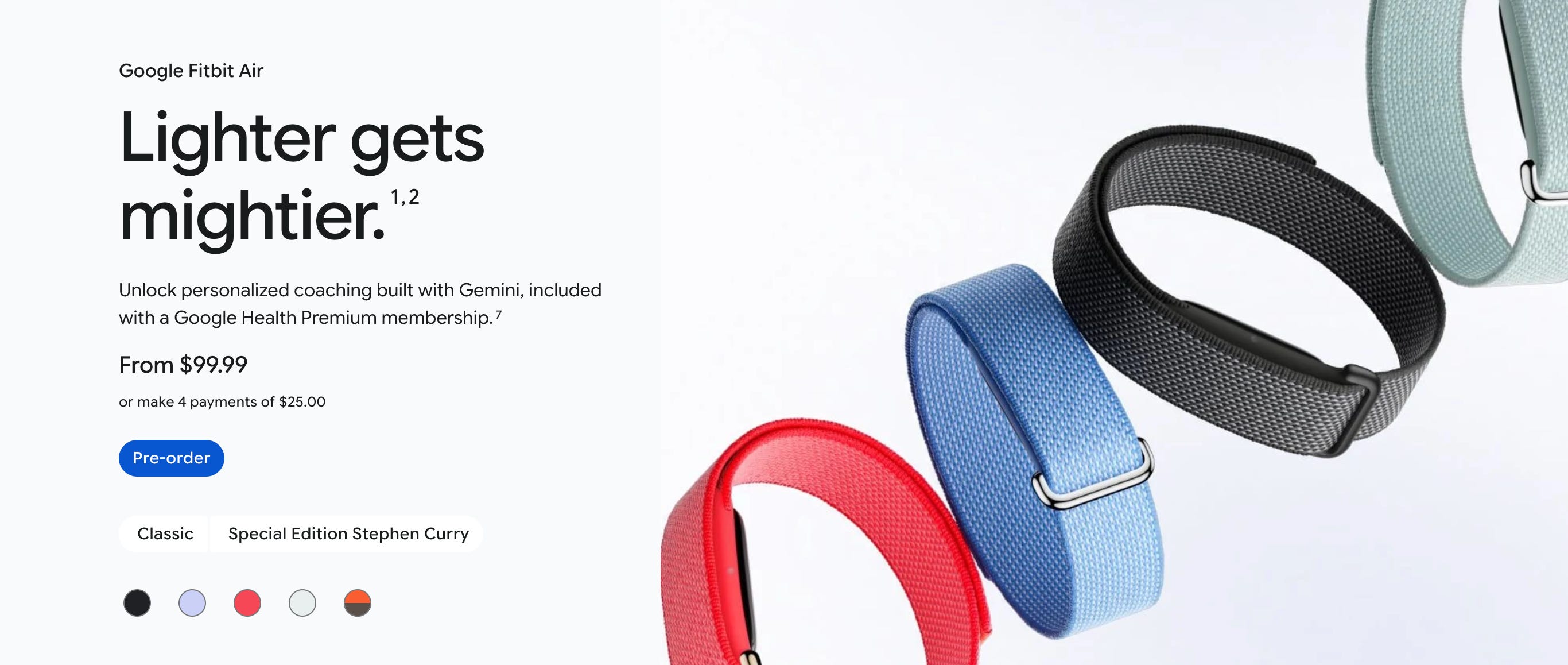
Ask a consumer electronics engineer how heavy a product should be and the answer is always lighter. Every gram is a tax, and the whole industry bends this way - from MacBooks to iPhones, and now the screenless Google Fitbit Air.
But this relentless pursuit of the featherweight has a cost.
I bought an Oura ring last year. It was six hundred dollars and it weighs 3.3 grams. A ring of that size in gold or silver would weigh closer to 20g. So you pick it up expecting twenty and you get three, and then something happens in the hand before the mind has caught up. A small recoil, the sense of having been handed a plastic prop instead of a serious object. It doesn’t matter that 3.3 grams is a triumph of miniaturization. The body has been calibrating the weight of metal for several thousand years, and it is not interested in your sensors.
For decades, we’ve bought into a diet culture for gadgets, an obsessive belief that taking up less physical space and shedding every possible gram is the ultimate design virtue. But jewelry is different.
Ask a jewelry designer how heavy a piece should be and the answer reverses. Not heavy, exactly, but heavier than it looks. From a gold chain with real presence at the collarbone to an earring that pulls just enough that you remember it’s there. Weight is how jewelry tells you it’s serious; it’s the difference between costume and the heirloom you would save in a fire.
I’m currently wrestling with this contradiction while building a piece of voice-enabled jewelry. It has to disappear, because nobody wants to wear a computer on their chest, but it also has to be present. A gadget you take off with relief and a necklace you forget on the counter are the same failure described from two different angles.
To bridge this gap, you have to move past “weight” as a number on a scale. The real design problem isn’t weight; it’s density. Aka the relationship between what an object looks like it should weigh and what it does when you lift it. Below a certain density, metal announces itself as hollow long before the eye notices. Inside the narrow, dense volume of the necklace you have to pack a battery, a board, a microphone, an antenna, and a clasp that will survive a decade of being put on and taken off.
I still think about the 3.3 grams of state-of-the-art engineering now sitting in my drawer. It’s true that human expectations can be re-trained over time - we eventually learned to accept that a premium laptop could and should feel as light as a notebook.
There isn’t a simple fix for this. You just have to make a choice. With this necklace, we’ve stopped trying to win the race to the bottom of the scale. We’re building it with a weight that feels intentional and accepting that to make a computer feel permanent, it must first dare to be heavy.
- Elena
Join the Journey
I actually didn’t think of it this way. I used to think Lighter was better, but seeing it from your own perspective, I now understand better.
I have literally forgotten that some things were in my hands, and that’s how they fell. And that can lead to it getting lost.
Yes! love this